

What is nexus?
nexus is a Go framework for building backends. You write a plain function with typed input and output. nexus serves it over REST, GraphQL and WebSocket from that one signature, injects its dependencies, and shows it on a live dashboard at /__nexus.
go
func (s *UserService) CreateUser(ctx context.Context, in CreateUserArgs) (*User, error) {
    return s.db.Create(ctx, in)
}

nexus.AsRest("POST", "/users", (*UserService).CreateUser)  // REST
nexus.AsMutation((*UserService).CreateUser)                // GraphQL
It has no schema files and no code-generation step you run by hand. You deploy one Go binary, with the frontend embedded in it.
What you get
- Handlers. One reflective handler shape across REST, GraphQL and WebSocket. Struct tags drive binding, validation and the GraphQL schema.
- Dependency injection. Constructors go into a DI graph. Handlers and services receive their dependencies as parameters.
- Controllers. A struct whose methods are the actions, with Rails-style resources, custom member and collection actions, and a per-action
Authorizehook. - Frontend. A normal Vite project (Vue, React or anything else) under
web/, embedded at build time. Inertia.js pages, resources and SSR are supported, with typed links and form actions generated from the Go routes. - Reactive views. Server-rendered templ components with signals that update in the browser without a JavaScript build, and LiveView-style live pages whose events run on the server and travel back as small patches over a WebSocket. Pages that keep their state in
view.Assignfields re-render only what changed. One kind of live view is routed as a page or embedded in another; streams, presence and live uploads work as they do in Phoenix LiveView. - Client SDK. A typed JS/TS client and Vue composables, generated from your registered endpoints and served by the binary.
- Background jobs. Typed jobs with queues, retries, timeouts, progress, checkpoints and cron schedules, on an in-memory, SQL, Redis or RabbitMQ driver.
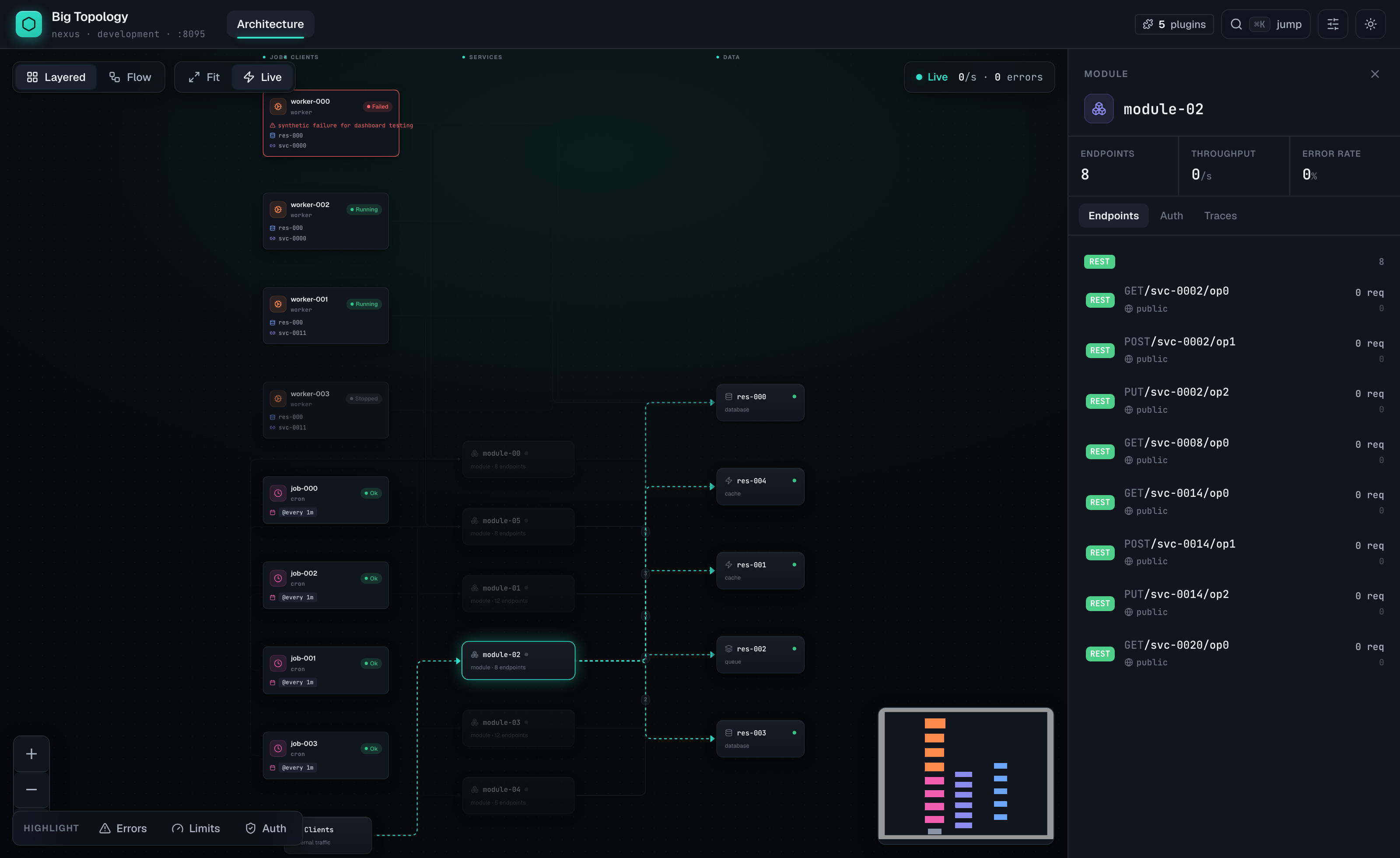
- Dashboard. A live architecture graph, an endpoint tester, traces, crons, rate limits and cached identities.
- ORM. Django-style models, QuerySets and lookups, relations in both directions, values and raw SQL, full-text and vector search, migrations, and one set of models over two schemas while a database is migrated.
- Batteries. Databases (GORM), caches (memory or Redis), file storage (local or S3), mail, sessions, auth and OAuth2, CSRF and security headers, workers and crons.
Design principles
- Plain Go first. A handler is an ordinary function or method. No framework interfaces to implement and no context wrapper to thread through your code.
- Pay for what you import. The default binary uses the standard-library router and a built-in DI container. GORM, SQL drivers, Redis, gin and fx are linked only when you import them.
- Secure by default. The dashboard returns 404 in production unless you open it. Security headers are on. WebSocket upgrades are same-origin. Tokens in the client SDK are held in memory.
- One binary.
nexus buildruns the Vite build, thengo buildembeds its output. The server needs no Node.js to run.
Requirements
- Go 1.26+. The build is pure Go: no CGO and no build tags.
- Node.js 20+ and npm, only when the app has a frontend. They are needed at development and build time, not at runtime.
Next: Getting started.